Pass-Through Entity Responsibilities: A Complete Checklist
Why Pass-Through Entity Compliance Is the Most Consequential Role in Federal Grants Management
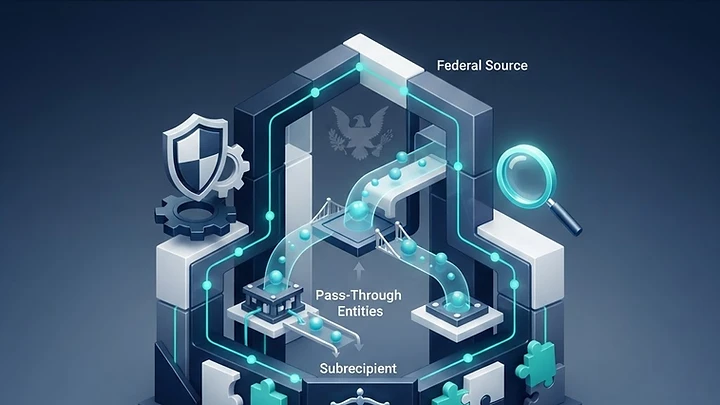
If you administer federal awards and distribute any portion of that funding to another organization, you are a pass-through entity (PTE). That designation is not merely a label — it triggers a comprehensive set of legal obligations that run parallel to, and in some cases exceed, the responsibilities of the federal awarding agency itself. PTEs sit at the most risk-concentrated intersection in the federal grants ecosystem: they are simultaneously accountable to the federal government above them and responsible for the performance and compliance of subrecipients below them.
The Office of Inspector General (OIG) and the Government Accountability Office (GAO) have repeatedly cited inadequate subrecipient monitoring as among the most common and costly findings in single audits. When a subrecipient misspends funds, the PTE — not just the subrecipient — faces potential repayment liability, adverse audit findings, and reputational damage with federal awarding agencies. Understanding and executing your full portfolio of PTE responsibilities is not an optional compliance exercise; it is financial and programmatic risk management at the highest level.
This comprehensive checklist walks through every major dimension of PTE responsibility under the Uniform Guidance, grounding each item in the regulatory text of 2 CFR 200. Whether you are building a monitoring program from scratch, stress-testing an existing one, or preparing for a single audit, this guide is designed to be your definitive operational reference. For an overview of the specific clauses that must appear in your subaward documents, see our companion piece, Essential Clauses in Subaward Agreements: A PTE Compliance Guide.
Checklist Area 1: Making the Subrecipient vs. Contractor Determination
Before any monitoring obligation can attach, a PTE must correctly classify the entity receiving funds. This threshold determination — subrecipient or contractor — is the foundational step that every downstream obligation depends on. Getting it wrong creates a compliance gap that can invalidate your entire monitoring framework.
The Distinguishing Criteria
Under 2 CFR 200.331, a subrecipient is an entity that receives a subaward to carry out part of a federal program. Key characteristics include: the entity determines who is eligible to receive federal assistance, has its performance measured against program objectives, has responsibility for programmatic decision-making, and uses federal funds to carry out a program of the federal awarding agency. A contractor, by contrast, provides goods or services within normal business operations, provides similar goods or services to many different purchasers, operates in a competitive environment, and is not subject to the compliance requirements of the federal program.
The nature of the relationship — not the label placed on the agreement — governs this determination. Misclassifying a subrecipient as a contractor to avoid monitoring obligations is a well-documented audit finding and a significant compliance risk. Document your determination and retain that documentation in your award file.
Fixed-Amount Subawards
For lower-risk, well-defined scopes of work, PTEs may issue fixed-amount subawards under 2 CFR 200.333, subject to federal awarding agency approval. Even under a fixed-amount structure, the PTE remains responsible for ensuring that the subrecipient met program objectives and that the agreed-upon deliverables were actually achieved.
Checklist Area 2: Pre-Award Risk Assessment of Prospective Subrecipients
The work of subrecipient monitoring begins long before a subaward is executed. A robust pre-award risk assessment is your most powerful tool for calibrating the intensity of post-award oversight. PTEs that skip this step frequently discover — too late — that they have awarded federal funds to an entity incapable of managing them.
Risk Factors to Evaluate
Under 2 CFR 200.332(b), PTEs must evaluate subrecipient risk using factors that may include the subrecipient's prior experience with the same or similar subawards, the results of previous audits including whether the subrecipient receives a single audit and the nature of any findings, whether the subrecipient has new personnel or new or substantially changed systems, and whether the subrecipient has not previously been monitored by the PTE.
Operationally, your pre-award checklist should include: a review of the subrecipient's most recent single audit report (if applicable) via the Federal Audit Clearinghouse; a SAM.gov search for active exclusions or suspensions; a review of the subrecipient's financial statements or most recent audit; an assessment of organizational capacity (staffing, accounting systems, internal controls); and a review of prior performance under similar awards. Document each factor and assign a risk rating — low, medium, or high — that will drive your monitoring intensity.
The SAM.gov Verification Requirement
Before issuing a subaward, PTEs must verify that prospective subrecipients are not suspended or debarred. This is a non-negotiable pre-award step. A failure to check SAM.gov and subsequently award funds to an excluded entity is an automatic audit finding with potential liability to the PTE.
Checklist Area 3: Executing a Compliant Subaward Agreement
The subaward agreement is the legal instrument through which a PTE flows down its federal obligations to the subrecipient. Under 2 CFR 200.332(a), PTEs are required to include specific information in every subaward at the time of award. A subaward that is missing required elements is not merely imperfect — it is a regulatory deficiency that can expose the PTE to audit findings and jeopardize the subrecipient's ability to properly manage the award.
Mandatory Subaward Elements
The required subaward content under 2 CFR 200.332(a) includes: the Federal Award Identification Number (FAIN); the federal award date; the period of performance start and end dates; the amount of federal funds obligated; the total amount of federal award committed to the subrecipient; the total approved cost-sharing or matching, if applicable; the name of the federal awarding agency and pass-through entity; a description of the federal program and the Assistance Listings (CFDA) number and title; any indirect cost rate for the subrecipient, including whether the rate is a federally negotiated rate, a de minimis rate, or a rate set by the PTE; the applicable requirements of the Uniform Guidance; and any additional requirements imposed by the PTE.
Flowing Down Federal Requirements
The PTE is responsible for ensuring that all applicable federal compliance requirements are flowed down to subrecipients. This includes requirements from the federal award, applicable statutes, and the Uniform Guidance itself. Critically, this includes whistleblower protections. As specified in 2 CFR 200.217: